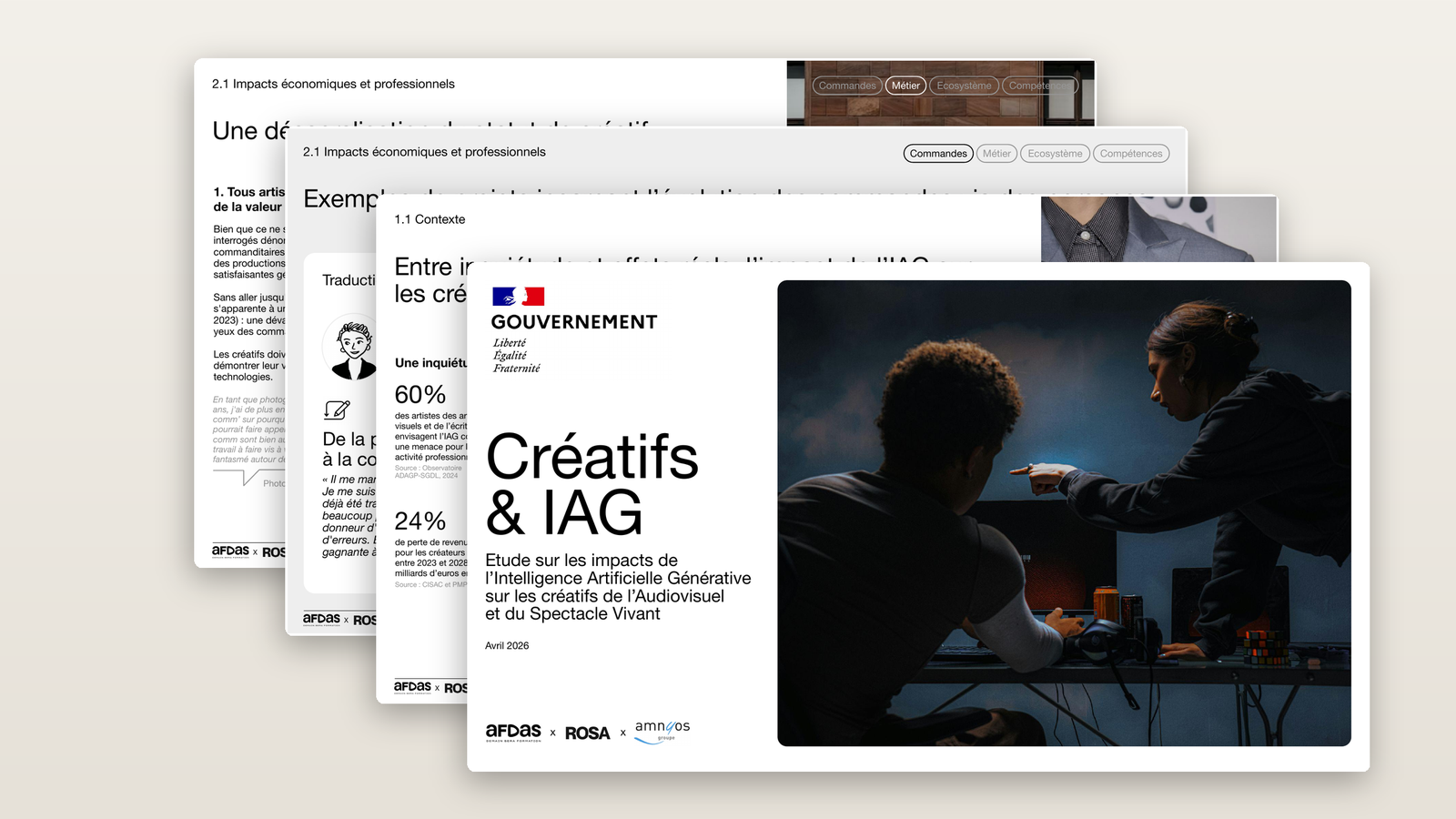
The study focuses on independent creatives, an already fragile population particularly exposed to generative AI, across live performance and audiovisual.
10 professions were selected across three categories: image and visual representation (illustrator, photographer, 2D/3D animator), writing and translation (composer-songwriter, playwright, screenwriter, set designer, director, translator, writer), and artistic performance (voice actor, musician, singer).
We conducted 40 interviews using an extreme-case sampling method, deliberately targeting both early AI adopters and highly exposed profiles to surface the clearest mechanisms of change.
Early signals are already visible. In a 2024 Afdas/ADAGP survey of 1,614 author-artists, 82% reported no effect from generative AI on their activity, 16% a decline, and 2% a positive effect. Projections point further out: CISAC and PMP Strategy estimate a 24% revenue loss for music creators by 2028, and a 21% threat to audiovisual creators' revenue — concentrated in dubbing and subtitling (-56%), screenwriting (-20%) and directing (-15%).
Rather than affecting whole professions evenly, the study's working hypothesis is that generative AI acts as an accelerator of polarization: it hits standardized tasks and intermediate positions in the creative value chain hardest, while reshaping the conditions of high-singularity artistic work at the edges. Across the professions studied, the team traced five distinct trajectories — bifurcation, erosion, steady continuation, consolidation, and expansion — rather than a single story of disruption.